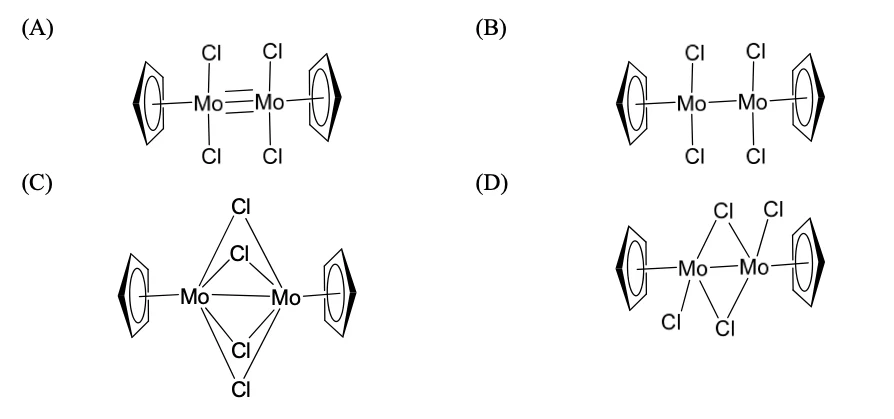
[CpMoClX2]X2 obeys the 18 electron rule. The correct structure of this compound is (atomic number of Mo = 42)
AStructure (A)
BStructure (B)
CStructure (C)
DStructure (D)
Show answer and explanation
Answer: C. Structure (C)
In structure C each Mo has Cp (5 e), two μ-Cl bridges (3 e each, shared) and a Mo-Mo bond, which brings each Mo to 18 electrons. Structure B, with only terminal Cl and a Mo-Mo single bond, leaves each Mo at 14 electrons.
During oxygen transport by hemerythrin, oxygen is bound as
AOX2X− to one Fe(III) only
BHOX2X− to one Fe(III) only
COX2X2− to one Fe(II) and one Fe(III)
DOX2X2− to two Fe(II)
Show answer and explanation
Answer: B. HOX2X− to one Fe(III) only
In oxyhemerythrin both irons are oxidised to Fe(III) and the dioxygen is reduced and protonated to hydroperoxide, bound end-on to only one Fe(III). Option C is tempting but both irons are Fe(III) in the oxy form.
At pH 7.2 and 10 Torr oxygen partial pressure, the extent of OX2 binding is
Ahigh for both hemoglobin and myoglobin
Bhigh for hemoglobin and low for myoglobin
Chigh for myoglobin and low for hemoglobin
Dlow for both hemoglobin and myoglobin
Show answer and explanation
Answer: C. high for myoglobin and low for hemoglobin
Myoglobin has a hyperbolic binding curve with P50 about 1-3 Torr, so it is mostly saturated at 10 Torr, while cooperative hemoglobin (P50 about 26 Torr) is poorly saturated at this low pressure.
In the first row high-spin transition metal complexes [M(HX2O)X6]ClX2 with d5 and d7 metal ions, the d-d transitions are
Aspin-forbidden for both
Bspin-allowed for both
Cspin-forbidden for d5 and spin-allowed for d7
Dspin-allowed for d5 and spin-forbidden for d7
Show answer and explanation
Answer: C. spin-forbidden for d5 and spin-allowed for d7
High-spin d5 (6A1g) has no other sextet term, so all its d-d bands are spin-forbidden; high-spin d7 (4T1g) has quartet excited states, so its transitions are spin-allowed.
Among the given boranes and heteroboranes, the example which belongs to 'closo' type is
ABX5HX8X−
B[CX2BX9HX11]X2−
CGeCX2BX9HX11
DBX6HX10
Show answer and explanation
Answer: C. GeCX2BX9HX11
GeCX2BX9HX11 has 12 vertices and 13 skeletal electron pairs (n+1), so it is closo. [CX2BX9HX11]X2− (dicarbollide) has 11 vertices and 13 pairs, so it is nido; BX5HX8X− and BX6HX10 are also nido.
The reaction of PX2OX5 with HNOX3 and HClOX4, respectively, gives
ANOX2 and ClOX2
BNX2OX5 and ClX2OX6
CNX2OX3 and ClX2OX7
DNX2OX5 and ClX2OX7
Show answer and explanation
Answer: D. NX2OX5 and ClX2OX7
PX2OX5 dehydrates the acids to their anhydrides with the same oxidation state: HNOX3 (N +5) gives NX2OX5 and HClOX4 (Cl +7) gives ClX2OX7. ClX2OX6 in B has the wrong oxidation state.
When crystals of sodium chloride are heated in the presence of sodium vapor, they turn yellow. This is due to the formation of
ASchottky defects
BFrenkel defects
CF-centres
DH-centres
Show answer and explanation
Answer: C. F-centres
Excess Na ionises and the electrons occupy anion vacancies (F-centres), which absorb visible light and give the yellow colour. Schottky defects alone do not colour the crystal.
One mole of an ideal gas is compressed from 5 L to 2 L at constant temperature. The change in entropy, in JK−1, of the gas is ____________. (R=8.314JK−1mol−1)
Show answer and explanation
Answer: Accepted answer: -7.65 to -7.48
ΔS=nRln(V2/V1)=8.314ln(2/5)=−7.62JK−1. Forgetting that compression lowers entropy gives the positive value.