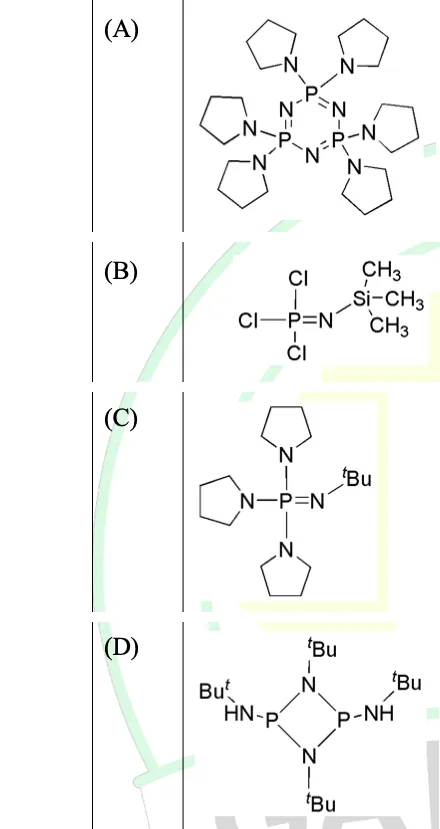
The phosphazene compound that acts as a superbase is
AStructure (A)
BStructure (B)
CStructure (C)
DStructure (D)
Show answer and explanation
Answer: C. Structure (C)
Phosphazene superbases (Schwesinger bases) are acyclic iminophosphoranes where protonation at the basic imino nitrogen (=N-tBu) is strongly stabilized by resonance delocalization of the positive charge across the three electron-donating pyrrolidinyl groups. Structure (C) is the well-known t-Bu-P1(pyrr) superbase (pKaH in MeCN≈28.4). Cyclic structure (A) distributes electrons within the six-membered inorganic ring and lacks the localized, highly basic imino site, making it significantly less basic.
The reaction for the synthesis of MeX2SiClX2 through Rochow-Müller process is
ASiClX4+MeX2Zn0°C
BSi:Fe(9:1)+2MeCl300°C
CSi:Cu(9:1)+2MeCl300°C
DSiClX4+2MeMgBr0°C
Show answer and explanation
Answer: C. Si:Cu(9:1)+2MeCl300°C
The Rochow-Müller (direct) process synthesizes dimethyldichlorosilane (MeX2SiClX2) by reacting powdered silicon directly with chloromethane (MeCl) at around 250–300∘C using copper as the essential catalyst, typically forming an active CuX3Si phase. Option B fails because iron is ineffective as a catalyst for this transformation. Options A and D represent laboratory Grignard and organozinc alkylations rather than the industrial direct synthesis.
Upon cooling from room temperature, the magnetic susceptibility of MnO slowly increases until 118 K, and then it decreases. This phenomenon is known as
Aferromagnetism
Bparamagnetism
Cantiferromagnetism
Dferrimagnetism
Show answer and explanation
Answer: C. antiferromagnetism
Antiferromagnetic materials show a maximum in magnetic susceptibility at the Néel temperature (TN=118 K for MnO), above which thermal energy disrupts spin ordering causing paramagnetic behavior (susceptibility increases on cooling), and below which antiparallel exchange coupling locks spins, decreasing susceptibility. Option A fails because ferromagnets show a sharp increase in susceptibility below their critical Curie temperature rather than a decrease.
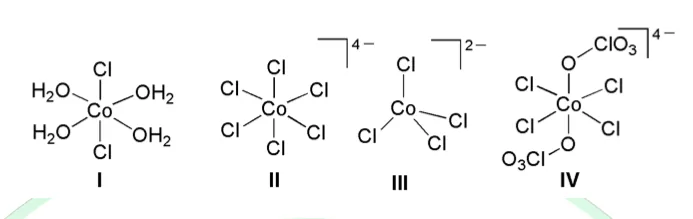
An aqueous solution of Co(ClOX4)X2⋅6HX2O is light pink in colour. Addition of conc. HCl results in an intense blue coloured solution due to the formation of a new species. The new species among the following is
[Given: Atomic number of Co=27]
AI
BII
CIII
DIV
Show answer and explanation
Answer: C. III
The light pink aqueous solution contains the centrosymmetric octahedral ion [Co(HX2O)X6]X2+. Adding conc. HCl forms the tetrahedral complex [CoClX4]X2− (structure III), which is intensely blue because lack of a center of inversion relaxes the Laporte selection rule for d–d transitions. Octahedral complexes such as II fail because their Laporte-forbidden transitions produce much weaker absorption.
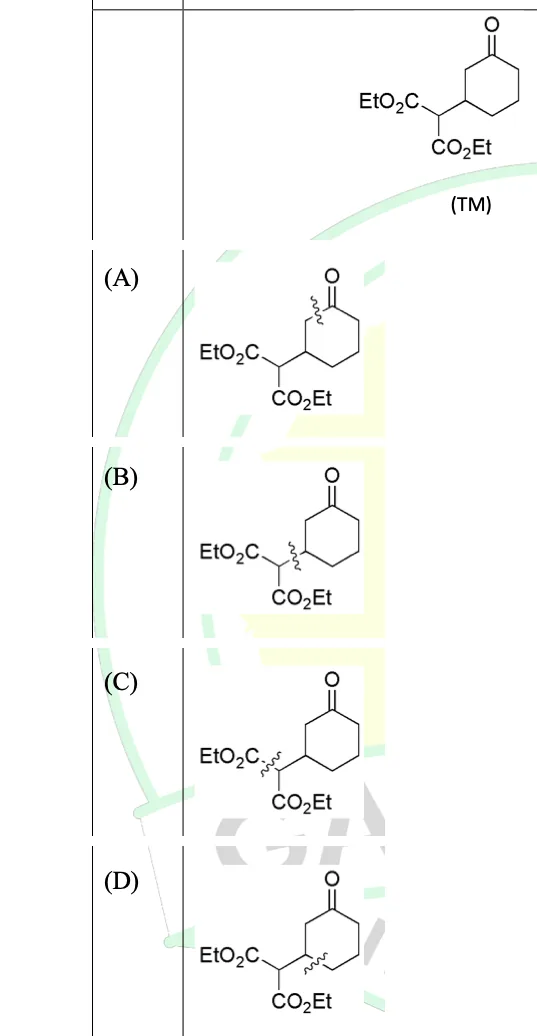
For an unambiguous single step synthesis of the following target molecule (TM), the best bond disconnection in its retrosynthetic analysis is
AStructure (A)
BStructure (B)
CStructure (C)
DStructure (D)
Show answer and explanation
Answer: B. Structure (B)
Disconnecting the bond between the ring and the malonate carbon, as in (B), reveals cyclohex-2-en-1-one and diethyl malonate as starting materials. Conjugate (Michael) addition of the resonance-stabilized malonate enolate to the α,β-unsaturated ketone affords the target molecule cleanly in a single step. Ring-cleavage disconnections like (A) or (D) require complex cyclization precursors and risk regiochemical ambiguity.
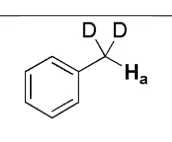
In the 1H-NMR spectrum of the following molecule, the signal of proton Ha appears as
Asinglet
Btriplet
Cquintet
Dquartet
Show answer and explanation
Answer: C. quintet
The multiplicity of a proton coupled to n equivalent nuclei with nuclear spin I is given by 2nI+1. In the structure, Ha couples with two equivalent deuterium atoms (n=2), each having spin I=1. This yields 2(2)(1)+1=5 lines, appearing as a quintet. Option B incorrectly assumes deuterium has spin I=1/2, which would give a triplet.
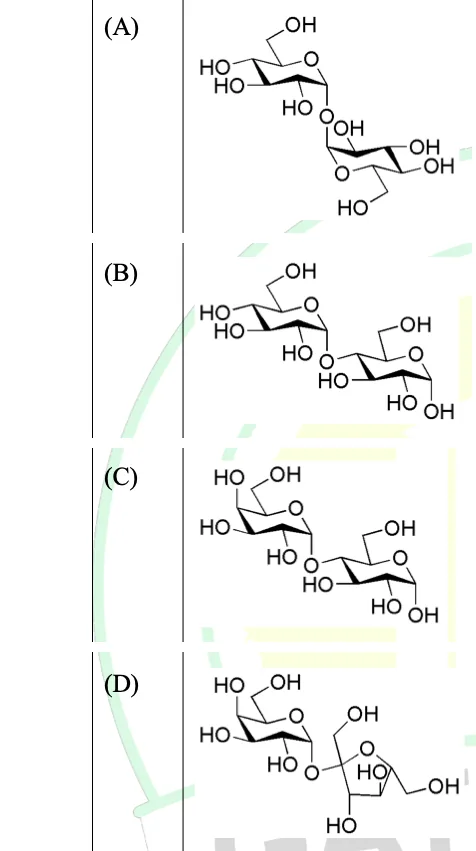
A disaccharide X does NOT show mutarotation in aqueous solution. Acidic hydrolysis of X affords two different monosaccharides. The disaccharide X is
AStructure (A)
BStructure (B)
CStructure (C)
DStructure (D)
Show answer and explanation
Answer: D. Structure (D)
A disaccharide does not undergo mutarotation if both anomeric carbons participate in the glycosidic bond, leaving no free hemiacetal or hemiketal group. In structure (D), the anomeric carbon of the pyranose ring is linked to the anomeric carbon (C2) of the furanose ring, making it non-reducing; acidic hydrolysis yields two distinct monosaccharides. Although (A) is also non-reducing, it hydrolyzes to give two identical monosaccharide units, while (B) and (C) possess a free hemiacetal and mutarotate.
The symmetry element that does NOT belong to C4v point group is
AC4
BC2
Ci
Dσv
Show answer and explanation
Answer: C. i
The symmetry operations of the C4v point group are E, 2C4, C2, $2 u_v,and2 u_d.AcenterofinversioniisabsentbecauseitspresencealongsideC_4and u_vwouldgenerateahorizontalmirrorplane u_h,resultinginthecentrosymmetricD_{4h}pointgroupinstead.OptionBbelongstothegroupbecauseC_4^2isinherentlyequivalenttoaC_2$ rotation.
Rigid rotor wavefunctions are given by Yl,m(θ,ϕ). The wavefunctions Y1,0(θ,ϕ) and Y2,0(θ,ϕ) are given below
Y1,0(θ,ϕ)=4π3cosθY2,0(θ,ϕ)=16π5(3cos2θ−1)
For a non-polar diatomic molecule, the value of transition dipole moment integral for transition between Y1,0(θ,ϕ) and Y2,0(θ,ϕ) is equal to
A1/2π
B0
C2
D1/4π
Show answer and explanation
Answer: B. 0
The transition dipole moment operator for pure rotational transitions is proportional to the molecule's permanent dipole moment, μ^=μ0cosθ. For a non-polar diatomic molecule, the permanent dipole moment is zero (μ0=0), so the entire transition dipole moment integral vanishes regardless of the angular wavefunctions. Evaluating just the angular integral ∫Y2,0∗cosθY1,0dΩ incorrectly assumes a nonzero dipole moment, tempting choices like A or D.
The translational, vibrational, and rotational molecular partition functions for a system containing ideal diatomic gas molecules in the canonical ensemble (N, V, T) are written as, qtrans, qvib, and qrot, respectively. The option that correctly defines their thermodynamic variable(s) dependency is
Aqtrans(T,V), qvib(T,V), qrot(T,V)
Bqtrans(T,V), qvib(T), qrot(T)
Cqtrans(T), qvib(T,V), qrot(T)
Dqtrans(T,V), qvib(T), qrot(T,V)
Show answer and explanation
Answer: B. qtrans(T,V), qvib(T), qrot(T)
The translational partition function qtrans=(2πmkBT/h2)3/2V is directly proportional to volume, depending on both T and V. In contrast, the internal partition functions qrot≈kBT/(σB) and qvib=(1−e−hν/kBT)−1 depend solely on molecular constants and temperature T, being independent of volume. Option A fails because it incorrectly assumes rotational and vibrational states depend on container volume.
55 more questions from this paper are in the app
In the Tatva app you get the whole paper with the real clock and marking, every answer explained, your score, and an AI tutor for each mistake.