The INCORRECT statement about the solid-state structure of CsCl and CaFX2 is:
ACations in both solids exhibit coordination number 8.
BCsCl has bcc type structure and CaFX2 has cubic close pack structure.
CRadius ratio for Cs/Cl and Ca/F is 0.93 and 0.73, respectively.
DBoth exhibit close pack structure.
Show answer and explanation
Answer: D. Both exhibit close pack structure.
CsCl is a simple cubic (bcc-type) arrangement, not close packed, so 'both close packed' is false. B is tempting but true: Ca2+ ions in fluorite form a ccp (fcc) array.
The INCORRECT statement about the interhalogen compound IClX3 is:
AIt exists as a dimer.
BGeometry around the iodine is tetrahedral in solid-state.
CIt decomposes as ICl and ClX2 in gas-phase.
DLiquid IClX3 conducts electricity.
Show answer and explanation
Answer: B. Geometry around the iodine is tetrahedral in solid-state.
Solid IX2ClX6 has each iodine square planar (four Cl plus two lone pairs), not tetrahedral. Conduction of the liquid (D) is true, through self-ionisation to IClX2X+ and IClX4X−.
AThey are thermally unstable because of the Si–C bond.
BThey are insoluble in water.
CThey are organosilicon polymers.
DThey have stable silica-like skeleton (–Si–O–Si–O–Si–).
Show answer and explanation
Answer: A. They are thermally unstable because of the Si–C bond.
Silicones are known for high thermal stability thanks to the strong Si–O backbone and stable Si–C bonds, so A is false. The other three are textbook properties.
Bincrease in overall entropy mostly due to increase in solvent entropy.
Cincrease in overall entropy mostly due to increase in solute entropy.
Dincrease in overall entropy and decrease in enthalpy.
Show answer and explanation
Answer: B. increase in overall entropy mostly due to increase in solvent entropy.
Micellisation is entropy-driven: structured water around the hydrocarbon tails is released (hydrophobic effect). A is tempting because the surfactant itself becomes more ordered, but the solvent gain dominates.
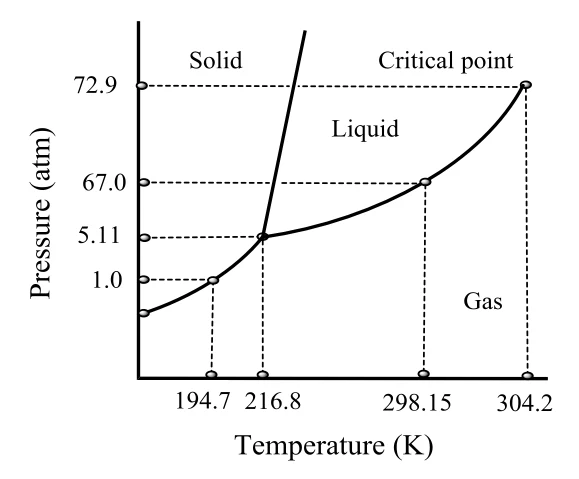
Consider the following phase diagram of COX2 (not to scale; triple point 216.8 K, 5.11 atm; sublimation at 1.0 atm, 194.7 K; liquid–gas point 298.15 K, 67.0 atm; critical point 304.2 K, 72.9 atm). At equilibrium, the INCORRECT statement is:
AAt 200 K, on increasing the pressure from 1 to 50 atm, COX2 gas condenses to liquid.
BIt is not possible to obtain liquid COX2 from gaseous COX2 below 5.11 atm.
CBoth liquid and gas phase of COX2 coexist at 298.15 K and 67 atm.
DWith increasing pressure, the melting point of solid COX2 increases.
Show answer and explanation
Answer: A. At 200 K, on increasing the pressure from 1 to 50 atm, COX2 gas condenses to liquid.
200 K is below the triple-point temperature (216.8 K), so compressing the gas there gives solid, not liquid. D is true because the solid–liquid line slopes forward (positive dT/dp).
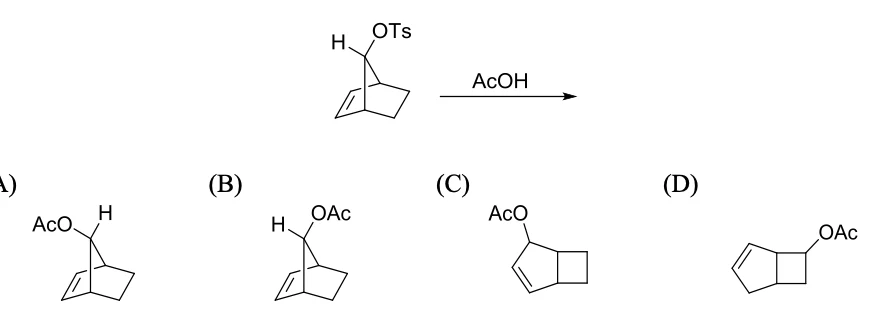
The major product formed in the following reaction is: 7-norbornenyl tosylate (OTs at C7, anti to the C=C) heated in AcOH.
AStructure (A)
BStructure (B)
CStructure (C)
DStructure (D)
Show answer and explanation
Answer: B. Structure (B)
The C=C π bond assists ionisation from the back side, forming a non-classical cation; acetate then attacks anti to the π bond, giving the 7-acetate with overall retention (B). A, the epimer with inversion, is the usual trap.
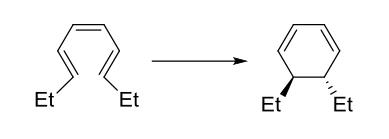
The Woodward-Hoffmann condition to bring out the following transformation is: (2E,4Z,6E)-deca-3,5,7-triene with terminal ethyl groups (as drawn) → trans-5,6-diethylcyclohexa-1,3-diene.
AΔ, conrotatory
BΔ, disrotatory
Chν, disrotatory
Dhν, conrotatory
Show answer and explanation
Answer: D. hν, conrotatory
A 6π electrocyclisation is disrotatory thermally, which would turn the E,Z,E triene into the cis product. The trans product needs conrotatory closure, which is photochemical. B is the thermal path, which gives the cis isomer.
55 more questions from this paper are in the app
In the Tatva app you get the whole paper with the real clock and marking, every answer explained, your score, and an AI tutor for each mistake.