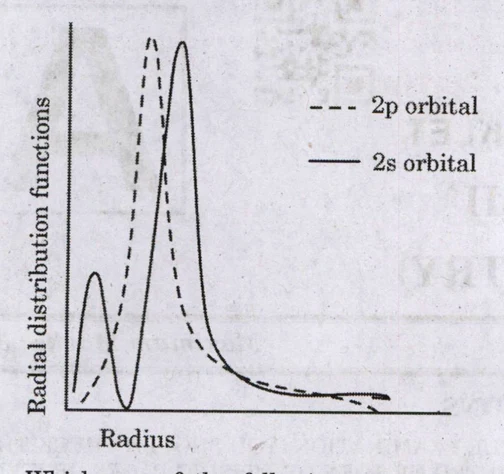
Consider the following diagram regarding the radial distribution function for 2s and 2p orbitals (dashed line: 2p orbital; solid line: 2s orbital; radial distribution function plotted against radius). Which one of the following statements is a correct conclusion drawn from the diagram given above?
A2s electrons are less shielded than 2p electrons.
B2p electrons are less shielded than 2s electrons.
C2s and 2p orbitals have equal probability of closer approach to nucleus.
D2s orbital electron density is at a greater distance from nucleus than that of 2p orbital.
Show answer and explanation
Answer: A. 2s electrons are less shielded than 2p electrons.
The small inner maximum of the 2s curve lies close to the nucleus, so 2s penetrates more and is shielded less than 2p. Option D is tempting because the main 2s maximum lies slightly further out, but penetration is governed by the inner lobe.
Which one of the following statements regarding wave functions is *not* correct?
AThe square of the wave function gives the probability of finding the electron in the space.
BThe angular wave function of a given type of orbital is dependent on the principal quantum number.
CThe radial function of 2s orbital is both positive and negative.
DThe probability of finding the electron density is zero at a node in the wave function.
Show answer and explanation
Answer: B. The angular wave function of a given type of orbital is dependent on the principal quantum number.
The angular part Yl,m(θ,ϕ) depends only on l and ml, not on n, so statement B is false. The 2s radial function does change sign at its radial node, so C is true.
Which one of the following rules for filling of atomic orbitals is violated in the electronic configuration 1s22s22px22py1?
AHund's rule of maximum multiplicity
BPauli's exclusion principle
CAufbau principle
DSlater's rule
Show answer and explanation
Answer: A. Hund's rule of maximum multiplicity
Pairing in 2px while 2pz is empty violates Hund's rule; the degenerate 2p orbitals should each be singly occupied first. Pauli is not violated since the paired electrons have opposite spins.
Solutions of alkali metals in liquid ammonia are deep blue irrespective of the type of alkali metal dissolved. The deep blue colour is due to:
AFormation of ammoniates of alkali metals
BGeneration of ammoniated electrons in solution
CFormation of alkali metal amides
DFormation of alkali metal hydroxides
Show answer and explanation
Answer: B. Generation of ammoniated electrons in solution
The blue colour comes from ammoniated (solvated) electrons absorbing in the red/near-IR, which is why it is independent of the metal. Amide formation (C) is the slow decomposition that discharges the colour.
The effective nuclear charge (Zeff) at the periphery of OX2− ion is:
A3.85
B3.50
C3.80
D3.45
Show answer and explanation
Answer: A. 3.85
The official key gives B. See the explanation for why A is correct.
The official key gives B (3.50), but Slater's rules give 3.85. OX2− has the configuration (1s)2(2s,2p)8. For an outermost 2p electron, the other seven n=2 electrons each contribute 0.35 and the two 1s electrons each contribute 0.85, so S=7(0.35)+2(0.85)=4.15. Hence Zeff=8−4.15=3.85, which is option A. A value of 3.50 does not come from any standard application of the rules.
109 more questions from this paper are in the app
In the Tatva app you get the whole paper with the real clock and marking, every answer explained, your score, and an AI tutor for each mistake.