Nitrogen is a non-metal, so nitrous oxide is a non-metal (covalent) oxide. BeO and Al2O3 are amphoteric but still oxides of metals, and Na2O is a basic metal oxide.
Arsenic (group 15) shows properties intermediate between metals and non-metals, so it is classed as a metalloid. It is an element, so 'alloy' is impossible, and it is not a typical non-metal like nitrogen.
Increasing order (lowest first) of the values of e/m (charge/mass) for electron (e), proton (p), neutron (n) and α-particle is
Ae, p, n, α
Bn, p, e, α
Cn, p, α, e
Dn, α, p, e
Show answer and explanation
Answer: D. n, α, p, e
The neutron has zero charge (e/m = 0); the alpha particle has charge +2 on mass 4 (ratio 1/2 of the proton's); the proton has 1/1; the electron, with about 1/1837 of the proton's mass, has the largest ratio. Option (c) wrongly puts the alpha particle above the proton.
Atoms of an element differing in mass but possessing the same chemical properties are called
AIsotones
BIsotopes
CIsobars
DIsomers
Show answer and explanation
Answer: B. Isotopes
Isotopes have the same atomic number (hence same electron configuration and chemistry) but different numbers of neutrons, so different masses. Isobars share mass number but are different elements.
The number of neutrons in the dipositive zinc ion (ZnX2+, with mass number 70) is
A34
B36
C38
D40
Show answer and explanation
Answer: D. 40
Neutrons = mass number - atomic number = 70 - 30 = 40; losing two electrons does not change the nucleus. Option (c), 38, comes from wrongly subtracting the charge too.
(CHX3)X2C=CH−C(CHX3)X3NaIOX4/KMnOX4 products. The products are
ACHX3COCHX3 and (CHX3)X3C−COOH
BCHX3COCHX3 and (CHX3)X3C−CHO
CCHX3COOH and (CHX3)X3C−COOH
DNone of these
Show answer and explanation
Answer: A. CHX3COCHX3 and (CHX3)X3C−COOH
The periodate-permanganate (Lemieux-von Rudloff) reagent cleaves the C=C; the disubstituted carbon becomes acetone and the CH end becomes an aldehyde that is further oxidised to 2,2-dimethylpropanoic acid. Option B stops at the aldehyde, which this oxidising mixture does not do.
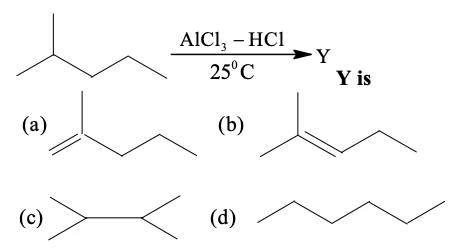
2-Methylpentane (shown in the figure) is treated with AlClX3−HCl at 25 °C to give Y. Y is:
AStructure (A)
BStructure (B)
CStructure (C)
DStructure (D)
Show answer and explanation
Answer: C. Structure (C)
Anhydrous AlClX3 with HCl isomerises alkanes through carbocation rearrangements toward more branched skeletons, so 2-methylpentane gives 2,3-dimethylbutane, structure (C). The alkenes in (A) and (B) would need dehydrogenation, and n-hexane in (D) is less branched.
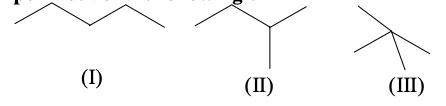
Which has maximum boiling point and melting point (respectively) out of the following: (I) n-pentane, (II) isopentane, (III) neopentane (skeletal structures shown in the figure)?
A(I) in both cases
B(I), (II)
C(I), (III)
D(II), (I)
Show answer and explanation
Answer: C. (I), (III)
n-Pentane has the largest surface area and strongest dispersion forces, so it has the highest boiling point. Neopentane is the most symmetrical molecule and packs best in the crystal, so it has the highest melting point. (a) is tempting because n-pentane leads in boiling point, but it does not lead in melting point.
An electron has a spin quantum number +21 and a magnetic quantum number −1. It cannot be present in:
Ad-orbital
Bf-orbital
Cs-orbital
Dp-orbital
Show answer and explanation
Answer: C. s-orbital
For an s orbital l = 0, so m can only be 0; an electron with m = -1 needs l >= 1 (p, d or f). (d) p-orbital is wrong because m = -1 is allowed for l = 1.
45 more questions from this paper are in the app
In the Tatva app you get the whole paper with the real clock and marking, every answer explained, your score, and an AI tutor for each mistake.