UP PGT Chemistry 2009: questions with answers and explanations
10 of the 76 questions, with answers and explanations. The full paper is in the Tatva app. Answers checked against a standard solved-papers book and by Tatva.
Which of the following heterocyclic compounds is not aromatic?
APyridine
BPyrrole
CFuran
DPiperidine
Show answer and explanation
Answer: D. Piperidine
Piperidine is a fully saturated six-membered ring with no π system, so it cannot be aromatic. Pyrrole (B) is aromatic because the nitrogen lone pair completes a 6π sextet.
Which one of the following is not an electrophile?
AHX−
BSiFX5X−
CBFX3
D:CHX2
Show answer and explanation
Answer: A. HX−
The hydride ion carries a lone pair and acts as a nucleophile or base, not an electron acceptor. Carbene (D) is electron-deficient and electrophilic, as is BFX3.
The most stable carbonium ion among the following is:
An-butyl
Bisobutyl
CSecondary butyl
DTertiary butyl
Show answer and explanation
Answer: D. Tertiary butyl
The tert-butyl cation is tertiary, so three alkyl groups stabilise it by hyperconjugation and inductive donation. sec-Butyl is secondary and next in stability; n-butyl and isobutyl are primary.
Schrock alkylidenes are formed from a triplet carbene fragment bonding to an early, high-oxidation-state metal, giving a covalent M=C double bond polarised with carbon nucleophilic. Singlet, electrophilic carbenes describe Fischer carbenes.
Reaction of R−CO−NHX2 with a mixture of BrX2 and KOH gives R−NHX2 as the main product. The intermediates involved in this reaction are
AR−CO−NHBr
BR−N=C=O
CR−NHBr
DBoth (a) and (b)
Show answer and explanation
Answer: D. Both (a) and (b)
In the Hofmann bromamide degradation the amide is first N-brominated to RCONHBr; its anion rearranges with loss of bromide to the isocyanate RNCO, which is hydrolysed to the amine. RNHBr is not formed.
The rate of SN2 reaction is maximum when the solvent is
ACHX3OH
BHX2O
CDMSO
DBenzene
Show answer and explanation
Answer: C. DMSO
DMSO is polar aprotic: it dissolves ionic nucleophiles but does not hydrogen-bond to the anion, leaving it highly reactive. Water and methanol solvate the nucleophile and slow SN2; benzene cannot dissolve the ionic reagents.
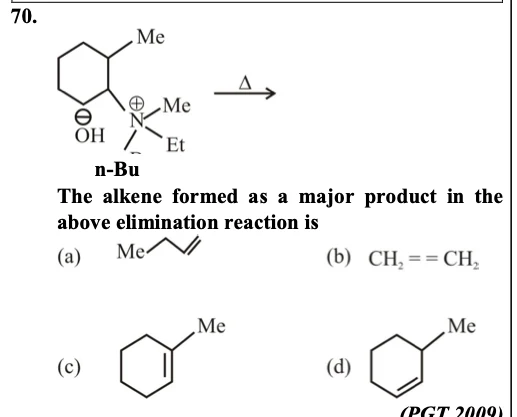
A 2-methylcyclohexyl(methyl)(ethyl)(n-butyl)ammonium hydroxide is heated (structure shown). The alkene formed as a major product in the above elimination reaction is
AStructure (A)
BStructure (B)
CStructure (C)
DStructure (D)
Show answer and explanation
Answer: B. Structure (B)
In Hofmann elimination the hydroxide removes the most accessible, most acidic β-hydrogen. The N-ethyl group has three unhindered primary β-H, so ethylene is expelled preferentially. 3-Methylcyclohexene is the tempting ring (Hofmann) alkene, but it is not the main product when an ethyl group is on nitrogen.
Which of the following decolourises alkaline KMnOX4 solution?
ACX3HX8
BCX2HX4
CCHX4
DCClX4
Show answer and explanation
Answer: B. CX2HX4
Cold dilute alkaline permanganate (Baeyer's reagent) hydroxylates C=C bonds, so ethylene is oxidised to ethylene glycol and the purple colour disappears. Saturated propane, methane and CClX4 do not react.
The treatment of CHX3MgX with CHX3C≡C−H produces
ACHX3−CH=CHX2
BCHX3C≡C−CHX3
CCHX3−CH=CH−CHX3
DCHX4
Show answer and explanation
Answer: D. CHX4
The terminal alkyne C–H is acidic enough to protonate the Grignard reagent, so CHX3MgX becomes methane and the alkynyl Grignard forms. No C–C coupling to 2-butyne occurs.
66 more questions from this paper are in the app
In the Tatva app you get the whole paper with the real clock and marking, every answer explained, your score, and an AI tutor for each mistake.