The known oxidation state(s) of Eu in aqueous solution is/are
A+2 and +3
B+3 and +4
C+2, +3 and +4
D+3 only
Show answer and explanation
Answer: A. +2 and +3
Europium has the ground-state configuration [Xe]4f76s2, so losing two electrons yields EuX2+ with an exceptionally stable half-filled 4f7 subshell. While +3 is the predominant oxidation state for lanthanoids in aqueous media, EuX2+(aq) is also well known and isolable despite acting as a strong reducing agent. Option D fails because it neglects the stability conferred by the half-filled f-orbital that allows EuX2+ to persist in aqueous solution.
The geometry around Te in the symmetrical trimeric species of [TeOX2F]X− is
ASquare planar
BTetrahedral
CTrigonal bipyramidal
DOctahedral
Show answer and explanation
Answer: C. Trigonal bipyramidal
In the cyclic trimer [TeX3OX6FX3]X3−, Te(IV) has one stereochemically active lone pair and forms four single/double bonds: two to bridging oxygens, one to a terminal oxygen, and one to fluorine. This gives a steric number of 4+1=5, dictating a trigonal bipyramidal arrangement (seesaw shape with the lone pair equatorial). Option B incorrectly ignores the lone pair, while option D assumes an expanded coordination number of six.
What is the order of decreasing carbonyl stretching frequencies in the following species (A – D)? A. [Mn(CO)X6]X+ B. [Os(CO)X6]X2+ C. [Ir(CO)X6]X3+ D. Free CO
AB>A>C>D
BD>C>B>A
CA>B>C>D
DC>B>D>A
Show answer and explanation
Answer: D. C>B>D>A
Higher positive charge on the metal center drastically reduces metal-to-ligand π-backdonation while increasing σ-donation and electrostatic polarization, strengthening the C−O bond above that of free CO (2143cm−1). Consequently, [Ir(CO)X6]X3+ (C) and [Os(CO)X6]X2+ (B) exhibit non-classical carbonyl behavior with νCO higher than free CO (D). In [Mn(CO)X6]X+ (A), normal π-backbonding lowers νCO below free CO, ruling out option B.
The 1H-NMR spectrum of [(CX5HX5)X2Fe(CO)X2] exhibits two peaks of equal intensity at room temperature, but four resonances of relative intensities 5:2:2:1 at lower temperature. The hapticities of CX5HX5X− are
Aη5 and η1
Bη5 and η3
Cη3 and η1
Dη3 and η3
Show answer and explanation
Answer: A. η5 and η1
To obey the 18-electron rule, Fe(II) (d6) coordinates to two CO ligands (4 e−), requiring 8 e− from the two cyclopentadienyl ligands, which corresponds to one η5-CX5HX5X− (6 e−) and one η1-CX5HX5X− (2 e−). At low temperature, ring whizzing stops; the η5-ring gives the peak of intensity 5, while the static η1-ring exhibits an A2B2X pattern of intensities 2:2:1. Option B fails because an η5,η3 combination gives a 20-electron complex and would not yield an intensity of 1.
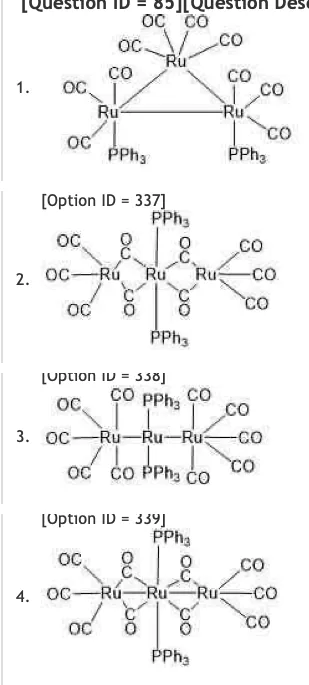
In the solid state, the stable structure of the metal cluster [RuX3(CO)X10(PPhX3)X2] is
AStructure (1)
BStructure (2)
CStructure (3)
DStructure (4)
Show answer and explanation
Answer: A. Structure (1)
The total valence electron count is 3×8+10×2+2×2=48 electrons, which requires (3×18−48)/2=3 metal-metal bonds. This dictates a closed triangular RuX3 core with all-terminal ligands, maintaining the geometry of parent RuX3(CO)X12 with two bulky PPhX3 ligands on separate metal centers. Linear trinuclear structures like (2), (3), and (4) have only two M−M bonds and would require 50 valence electrons.
The number of moles of Mg−ATP needed for the reduction of one mole of nitrogen by nitrogenase enzyme is
A8
B16
C6
D2
Show answer and explanation
Answer: B. 16
The overall stoichiometric reaction catalyzed by nitrogenase is NX2+8HX++8eX−+16MgATP2NHX3+HX2+16MgADP+16PXi. Transferring each of the 8 electrons from the Fe protein to the MoFe protein couples to the hydrolysis of two MgATP molecules, yielding a requirement of 8×2=16 moles of MgATP per mole of NX2. Option A (8) confuses the required number of electrons with the number of MgATP consumed.
Among SiX3NX4, α-BN, AlN and (SN)Xx, the compound with the highest conductivity is
ASiX3NX4
Bα-BN
CAlN
D(SN)Xx
Show answer and explanation
Answer: D. (SN)Xx
Polythiazyl, (SN)Xx, is an intrinsically conducting inorganic polymer that exhibits metallic conductivity along its chains at room temperature and becomes superconducting at 0.26K. In contrast, SiX3NX4, α-BN, and AlN are wide band gap electrical insulators with completely filled valence bands. Option B is tempting because α-BN shares a layered structure with graphite, but its large band gap (∼5.9eV) makes it an insulator rather than a conductor.
The number of valence electrons in X, Y, and Z are
AX=2; Y=3; Z=4
BX=4; Y=1; Z=1
CX=4; Y=3; Z=1
DX=1; Y=3; Z=4
Show answer and explanation
Answer: C. X=4; Y=3; Z=1
A sharp jump in successive ionization energies indicates the removal of an electron from a stable inner noble-gas core. For X, the massive increase occurs between IE4 and IE5 (6223 to 37830 kJ mol−1), signifying 4 valence electrons. Similarly, the largest jumps appear between IE3 and IE4 for Y and between IE1 and IE2 for Z, indicating 3 and 1 valence electrons, respectively. Option B mistakenly identifies Y as having only 1 valence electron.
The base ionization constant, Kb, of ammonia in water is 1.8×10⁻⁵. The value of acid ionization constant, Ka, of the conjugate acid is closest to
A5.6×10−10
B1.8×109
C7.0×10−7
D5.6×104
Show answer and explanation
Answer: A. 5.6×10⁻¹⁰
For a conjugate acid-base pair in water at 25∘C, the ionization constants are related by Ka×Kb=Kw=1.0×10⁻¹⁴. Thus, the acid ionization constant for NHX4X+ is Ka=Kw/Kb=(1.0×10−14)/(1.8×10−5)≈5.6×10−10. Option D fails because it simply calculates 1/Kb without multiplying by the autoionization constant of water, Kw.
An octahedral d6 complex has a single spin-allowed absorption band. The spin-only magnetic moment (B.M.) and the electronic transition for this complex, respectively, are
A0 and 1T1g←1A1g
B4.9 and 5T2g←5Eg
C4.9 and 5Eg←5T2g
D0 and 1T2g←1A1g
Show answer and explanation
Answer: C. 4.9 and 5Eg←5T2g
A high-spin octahedral d6 ion (t2g4eg2) has four unpaired electrons, giving μ=4(4+2)≈4.9 B.M. Its free-ion 5D term splits into a ground 5T2g and an excited 5Eg state, resulting in a single spin-allowed 5Eg←5T2g transition. Option B inverts the transition direction, while low-spin d6 complexes have μ=0 but exhibit two spin-allowed bands, ruling out A and D.
109 more questions from this paper are in the app
In the Tatva app you get the whole paper with the real clock and marking, every answer explained, your score, and an AI tutor for each mistake.